spout

June 27, 2006 spout writing

When to ship a book is hard to know these days…

Mr. Petzold beat me to the punch on the Windows Forms 2.0 book and he’s going to do it again on the RTM Avalon book. However, such a thing is dicey, as Mr. Petzold points out.

It was in researching the Windows Forms 1.0 book when I grew to be scared of finalizing a book before the technology was finalized; that’s when they added AllowPartiallyTrustedCallersAttribute and it screwed up the entire No-Touch Deployment story. Toward that end, we didn’t ship the WinForms 2.0 book til after the .NET 2.0 bits went gold and we won’t ship the paper copy of the Avalon 1.0 book til then, either (although I understand ORA is going to be shipping early electronic drafts of our work as we do it). I have to sacrifice 2-3 months on the shelves to my competitors, but I get to be less scared of big, last minute changes.

It’s a judgment call, though. In this era of books with 12-18 month shelf lives, I can’t say Mr. Petzold’s not right…

June 16, 2006 spout

PM Skill #9: Team Off-site

I’ve been doing some design work with a small part of my new team for a few months now and we’ve gotten largely on the same page with each other. However, there were 20-some odd folks that we hadn’t done a good job keeping on the same page, so ChrisAn proposed an off-site. I proposed the format:

  • 45-minute slots for each bucket” of design functionality with the owner of the bucket leading the discussion (my boss, Adam, wanted to make sure that at least half of each talk was *not* lecture from the speaker). Each session was followed with a 15-minute break.
  • 90-minute break-out sessions where each person had to pick their technology bucket and work with the owner to produce a 2-page functional spec and a 2-page technical spec.

If this format sounds like a tweaked DevCon to you, then you know where I got the format.

We started at 8am (1-2 hours before most folks start their day @ MS), so that gave us a little shared adversity to help build the team.

The 45 minute sessions made sure that the presenter had to get to the meat quickly, while the 15 minute breaks allowed folks some downtime to catch their breaths, check their email and chat with their brethren (this was a new team, so bonding” time was an important element).

The 90 minute break-outs allowed folks to self-select into the bucket that most interested them, validated that we had the right buckets (any bucket w/ too few people would be cut, whereas any bucket w/ too many people would be split), helped establish the base-line for each bucket’s future (we used the off-site to kick-start the buckets) and gave the team a seemingly impossible task given the amount of time they had (shared impossible task == more team building).

Like your average DevCon, the DesignCon” worked pretty well. We generated a ton of issues in each bucket that the owner hadn’t yet thought of and gave the entire team a kick-start down the road to shared pov. Also, since we had some folks from other, related teams and from upper management, we made sure we were communicating up and out as well as internally.

Of course, just as no DevCon is perfect, neither was the DesignCon, but if you’re looking for a way to get your team pointed in the same direction, I find the DesCon format a good one.

May 24, 2006 spout

T-Mobile Smartphone Fun Facts

A coupla weeks ago, the AT&T wireless cell phone reception at my house went through the floor. I called up the nice folks at Cingular and they guaranteed me that my reception would improve if I moved my old AT&T account to Cingular (Cingular owns both, after all). When that didn’t work, I went to the mall, signed up for T-Mobile, went to my house and, when the reception was much better, had em move my phone number over. Since then, I’ve been moving my smartphone along with me (I have a QTEK 8500 on order, but my Audiovox 5600 is still the greatest thing to happen to me since my first laptop). Here’s what I’ve found:

  • To get the data working (assuming you’ve selected that account option from T-Mobile), set up a GPRS connection that connects to the internet and uses wap.voicestream.com” as the Access Point (no user name, password or DNS addresses). There’s no need for a proxy connection, but make sure that your IE connection options use the internet as its network (I mistakenly had it set to WAP at first).
  • To use the phone as a modem for use in connecting to the internet, pair the phone w/ your computer using Bluetooth (make sure to put the phone into discovery mode so that Windows can find it) and then use the new COM port that Windows adds (COM4 on my machine) to set up a dial-up network connection, using *99#” as the phone number (no user name or password). I get this working when I called T-Mobile and they walked me through the setup, even though the Audiovox isn’t a supported phone and the tech support guy had no documentation on one.
  • This isn’t phone related, but once you’ve got a T-Mobile data plan, you should be able to use WiFi from your laptop at a T-Mobile HotSpot by using your 10-digit phone number as the user name and the last 4 digits of your SSN as your password (I haven’t tried this yet, but I plan to!).

Theoretically, I should be able to use ActiveSync via Bluetooth, but I haven’t figured out how to make that work yet.

So far, I’m loving T-Mobile, not just cuz of the rates and the features, but also because they seem to understand that some folks aren’t going to want to be stuck with the phones that they sell and they actually help you make them work. T-Mobile’s not the biggest network, but apparently that makes em try harder. Recommended.

May 23, 2006 spout

Don’t want to skew Amazon reviews

While I don’t mind being called tacky by one of this generation’s best technical writers, I do mind the idea that the folks that would abuse the system would skew the Amazon reviews. While I don’t hide the fact that I ask people to post reviews for my book, I’ve always been proud that I’ve never asked them what kind of review to post and, when Amazon’s system had a hiccup recently, none of my books had any reviews posted by me (unlike 50% of the other books on Amazon).

So, the idea that folks would just post a review having not even read the book was something I never considered (and why you don’t want me writing your security subsystem). So, consider this offer rescinded. You can post a review on Amazon or not, good or bad, as you choose.

However, as to the signed copies, I still want you to have those. So, the first 5 people to tell me the 2nd word in the 3nd paragraph of prose on page 444, I’ll send you a signed copy. Whether you purchase a copy or just go to the bookstore and look up the word is up to you.

May 22, 2006 spout

Google’s 2-day interview process

May 22, 2006 spout writing

Post an Amazon review and you get my royalties

Update: Whoops — didn’t think of the ways to abuse this system. I’ve updated the offer here.

If you post a legitimate review on Amazon for Windows Forms 2.0 Programming before the 4th of July, 2006, I will personally send you my royalties for that copy of the book ($4.77 — don’t spend it all in one place : ).

You have to put your email into the Amazon review so that I can communicate with you about your address and Sells Brothers, Inc. can send you a check, but good review or bad, my royalties for one copy of the book are yours.

The first five reviewers also get signed copies shipped to their home (I’ll get Mike to sign it, too). Again, the email needs to be in the post.

May 19, 2006 spout writing

WinForms 2.0 book @ the printer

WinForms 2.0 book @ the printer

The one where the brothers Sells and I travel to Ann Arbor, MI to see Windows Forms 2.0 Programming being printed. It’s well worth the trip, if you can talk the publisher into arranging it.

May 19, 2006 spout

The Sells Brothers Meet the Edwards Brothers

The Sells Brothers Meet the Edwards Brothers

Years ago, Tim Ewald made an off-handed comment about how cool the real book printing process was and that I should take the boys to see it if I ever got the chance. Two weeks ago, we got the change and this is what we saw.

The printer for Windows Forms 2.0 Programming was Edwards Brothers, Inc. in Ann Arbor, MI. The boys and I took the 8pm flight from Portland, OR to Vegas, then the 11pm flight to Detroit, arriving at 6am, having gotten about 3 hours of sleep during the flight (the boys first redeye!). On the way out the door, we’d been a little rushed (I was trying to finish off the flooring in the new laundry room so that Melissa could have her washer and drier back after its long absence during the renovations), so had left all of the carefully prepared contact info and directions sitting in my office, meaning that the first thing we had to do was to sit in the airport near a hotspot and download driving directions. This and a trip to the restroom for a teeth brushing and a fresh shirt and we had caught our 2nd wind.

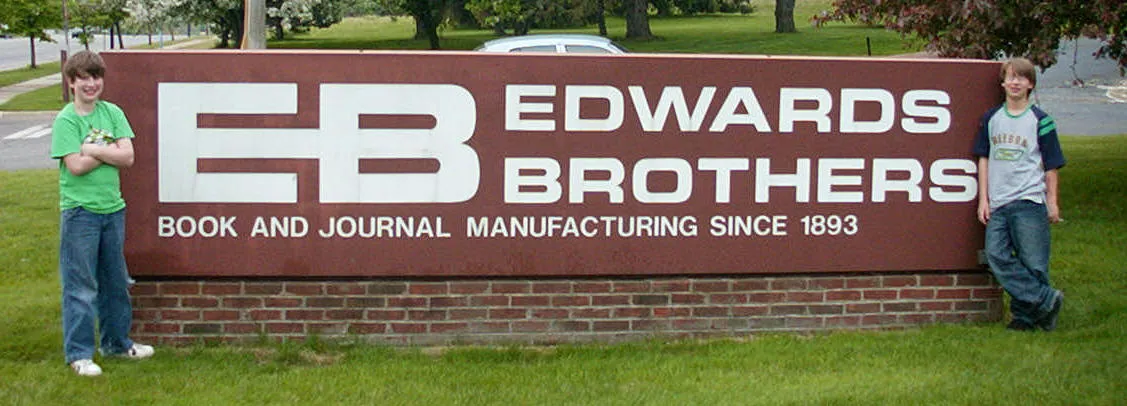
We picked up our car and had a very pleasant trip to Ann Arbor, where we stopped at Mike’s Coney Island for pancakes and omelets (I had the pancakes and my youngest surprised the hell out of me by ordering an omelet — they grow up so fast!). We arrived at Edwards Brothers around 7:30a (in some time zone) and learned that they had been in business for a little while longer than Sells Brothers, Inc:
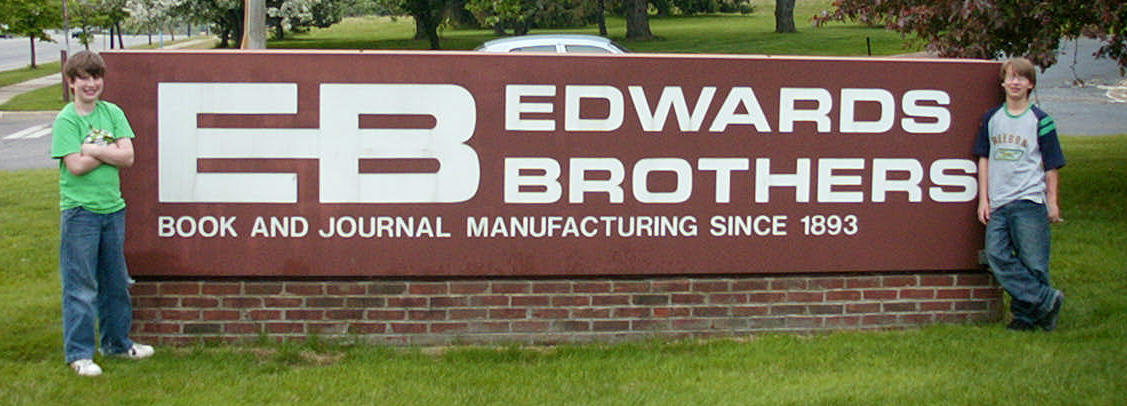
Unfortunately, we’d arrived before our escort, the very lovely Ms. Cindy Rohraff, so she caught us napping in the parking lot around 8am. Still, as we entered the lobby, it was clear that they were as excited to show us around their operation as we were to be there:
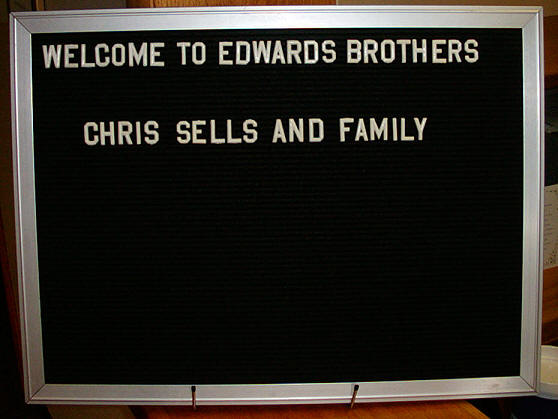
After Cindy purchased caffeinated sodas (Microsoft has spoiled me enough that I hadn’t come prepared to actually *purchase* sodas…), we began our tour and the first thing we saw was a big basket of the rejected bits of my book:
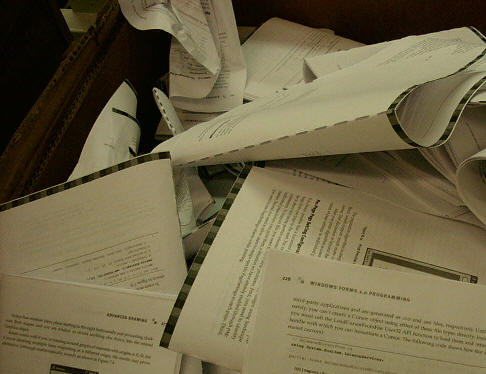
As it turns out, these bits weren’t rejected on content, but rather on printing quality. <whew>

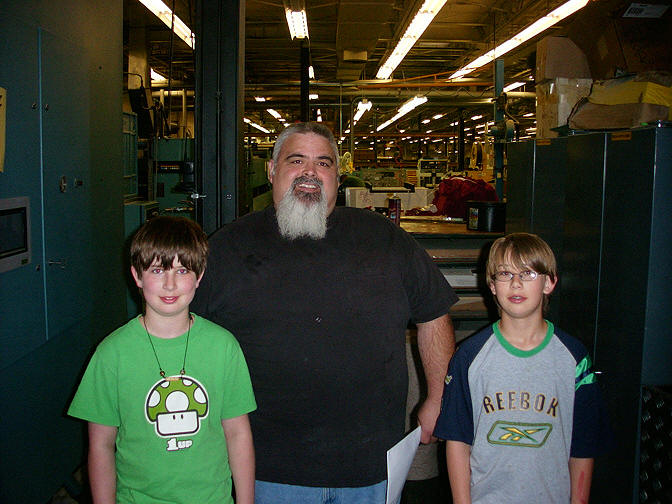
The size of the printing floor is enormous. It felt like 4+ football fields in there and I’m sure I saw at least 50 different books in various stages of production. In this picture of the boys and Daryl (in charge of printing our job), you can get some small sense of the size of the place:
For all those jobs, Edwards Brothers employees are constantly throwing away covers, inserts and signatures” (bundles of pages that get stuck together to produce a book) that don’t meet their quality standards. In fact, I saw one guy throwing away what must’ve been 100 freshly printed book covers because he’d examined one of them with a magnifying glass and found a flaw. These guys are serious.

Next, we found our way to the input end of the printer, where they feed in 2-ton rolls of paper:
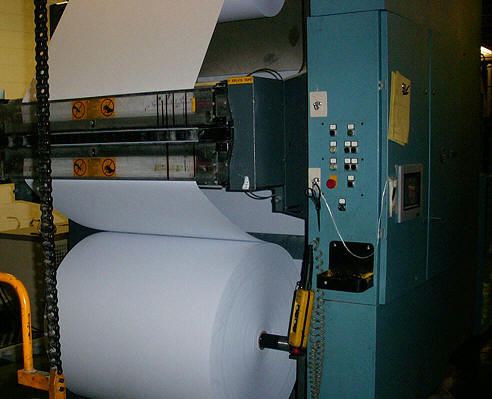
If you look closely, you’ll see that their are two rolls of paper connected here. Only one is fed through at a time, but when the first is out, the 2nd is spliced in automatically without ever slowing down the printing process, providing a virtual infinitely long roll of paper. A cache of paper is kept on rollers to enable the time it takes to splice:
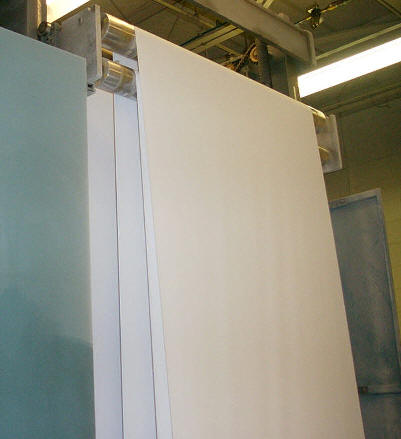
When the splice happens, the rollers at the top and the bottom (not shown) get close together as the cache is used up and then after the splice, the rollers expand again as the cache fills up. That’s not to say that the printer doesn’t stop at all. When it’s running, the paper goes through the process so fast, the words and images are a blur, but whenever there’s a problem, the process grinds to a halt and restarts w/o issue.

After the cache, the paper feeds into the printing machine (or machines, depending on how many colors the output needs):
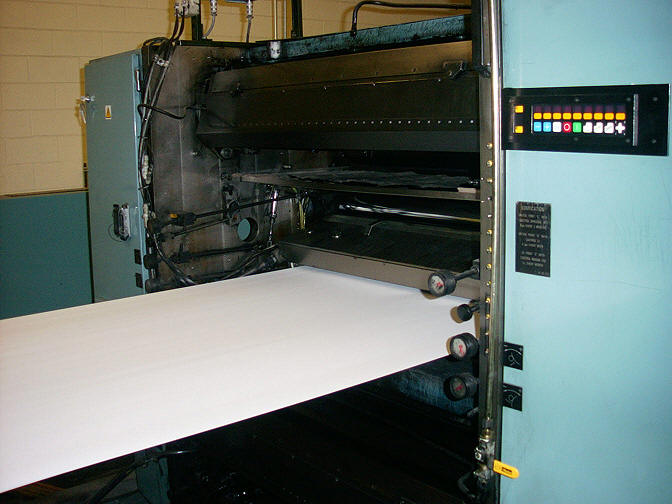
and comes out all printed:
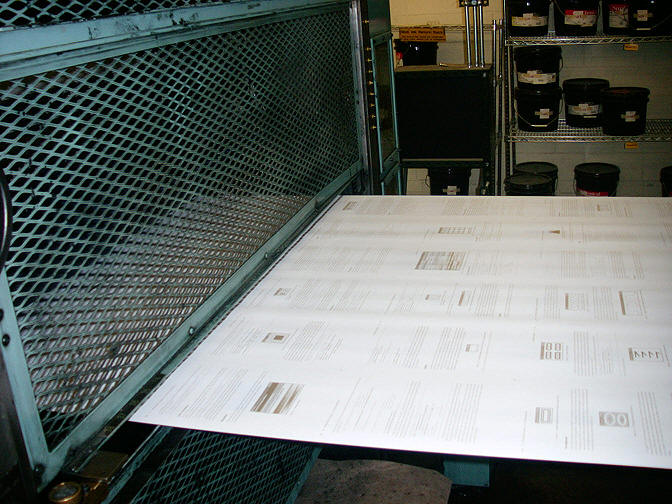
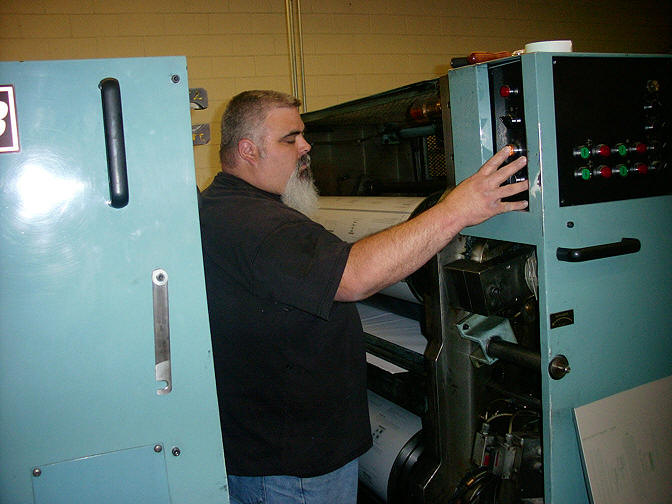
The printing itself happens with ink that’s been spread over thin metal plates containing the laser-etched images of the book in 48 page sets, one plate for each side. The paper goes through the printer between the two plates. Here you can see Daryl changing the plates:
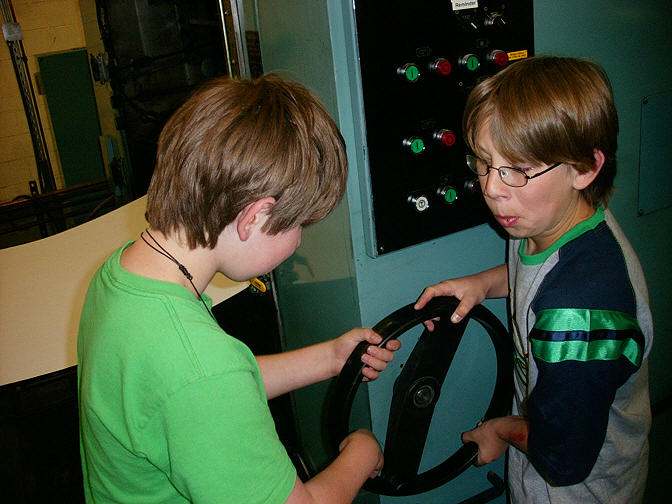
To support the ability to change the plates, the printer opens in the middle with hand cranks, which Daryl let the boys operate:
Daryl was one of the long list of people that bent over backwards to show us around and explain to us the process (Thanks, Daryl!). The plates themselves are shown here:
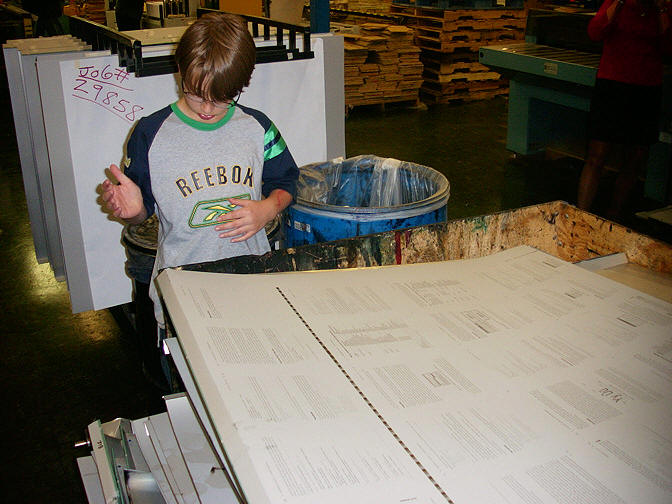
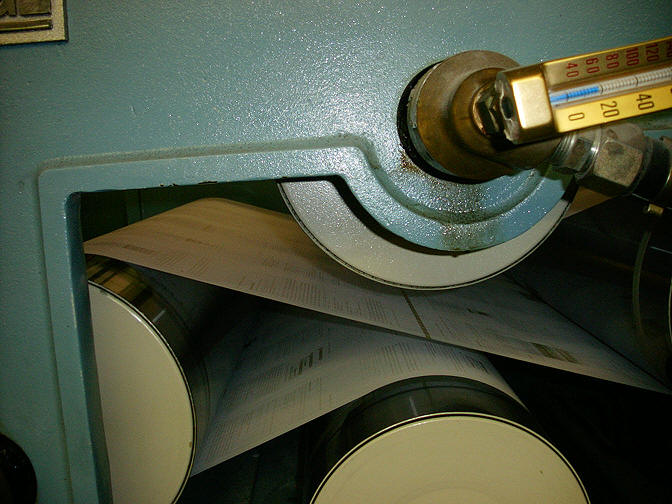
After the pages are printed, they’re rolled and cooled to set the ink:
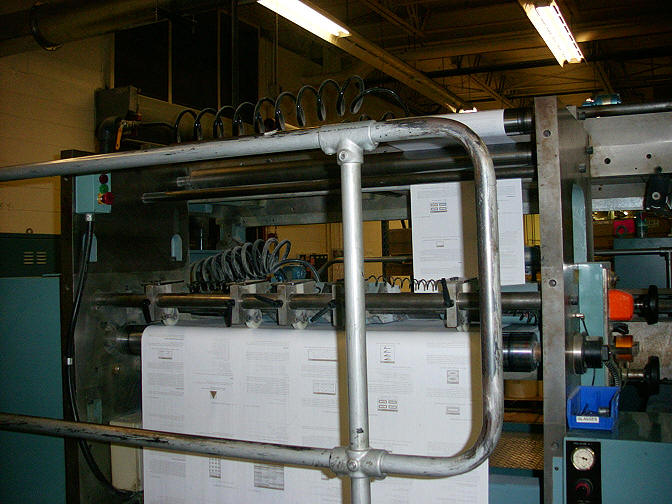
After the ink is set, the paper goes into a machine that cuts it and turns it along three separate paths (you can see one of the paths continue over the top of the cutter):
Each path of paper is routed through a folding and bundling machine:
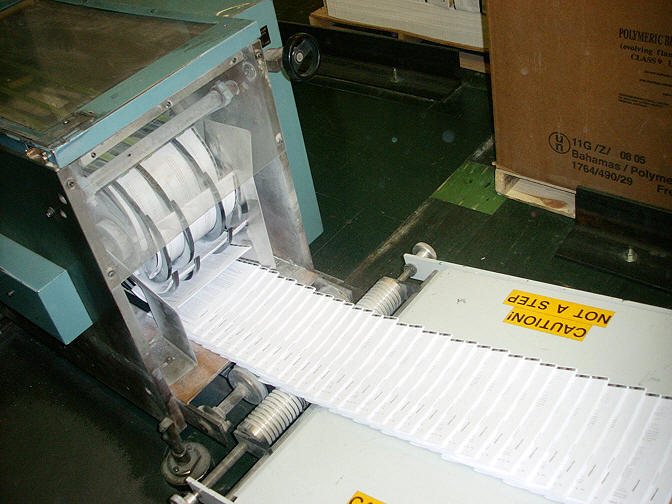
Once out of the bundling machine, the bundles are gathered together:
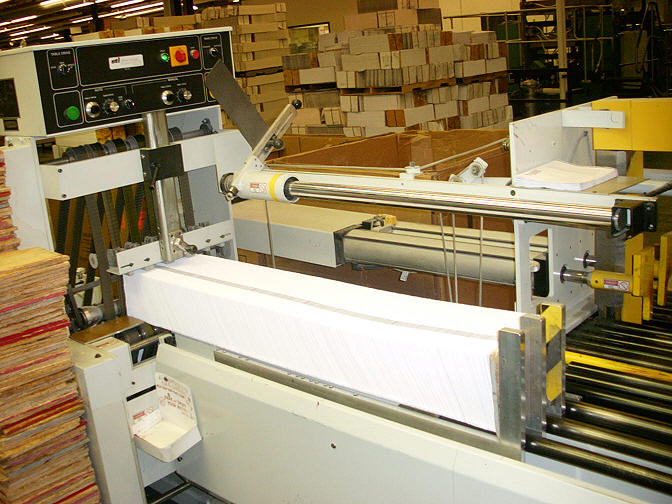
compressed (losslessly):
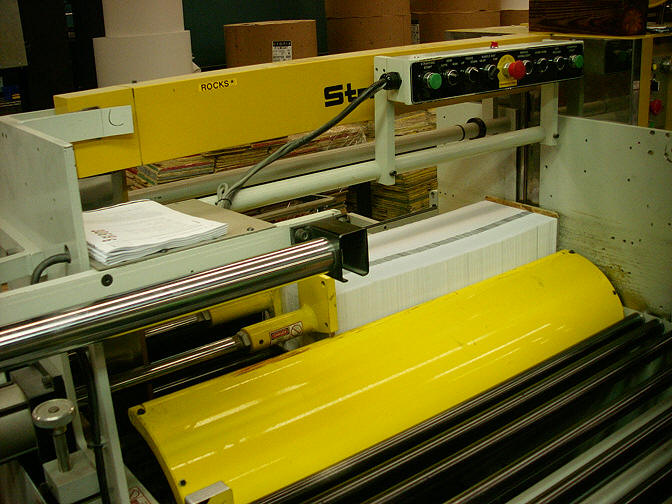
and stacked on pallets in sections (my book had 27 sections) for transport to the bundling department:
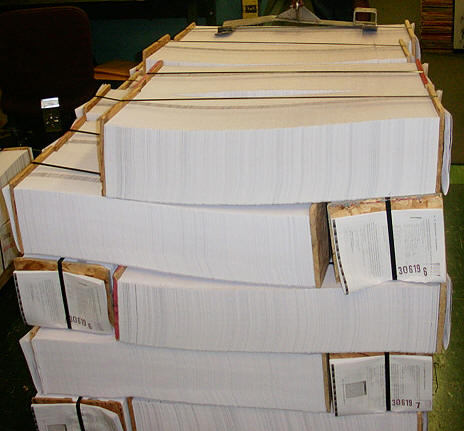
In my case, the cover:
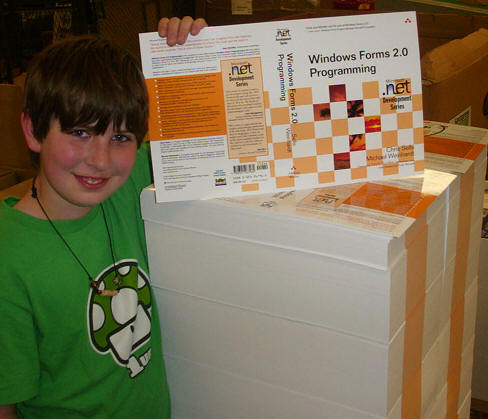
and the color insert:
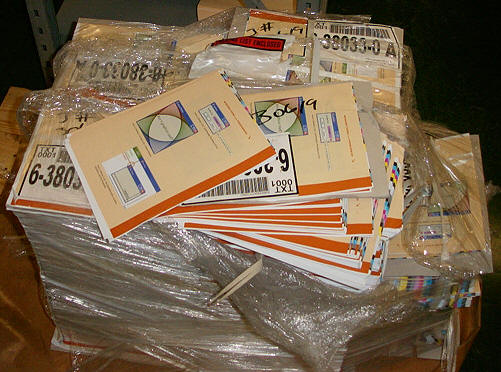
were printed by another vendor, but Edwards Brothers is fully capable of printing these elements. In fact, my book is pretty trivial compared to the tricks that the EB folks can do. I think next time, I’ll ask for a two-part cloth-bound hardcover with stained edges just to test em. : )

All 6500 copies were printed in one day and stacked over in the binding section of the printing plant (and again, notice the size of this place):
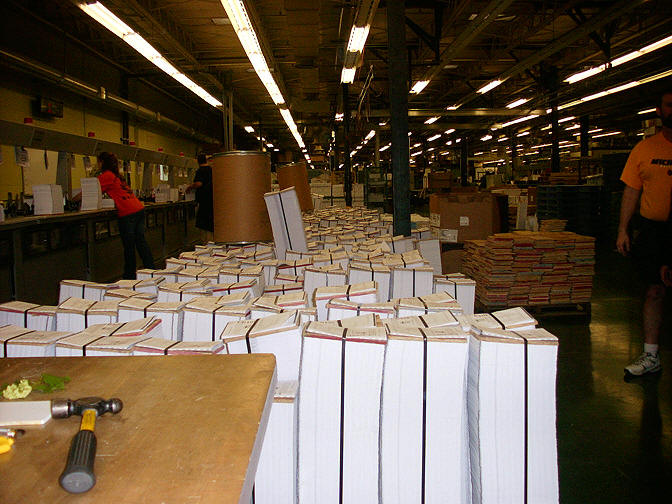
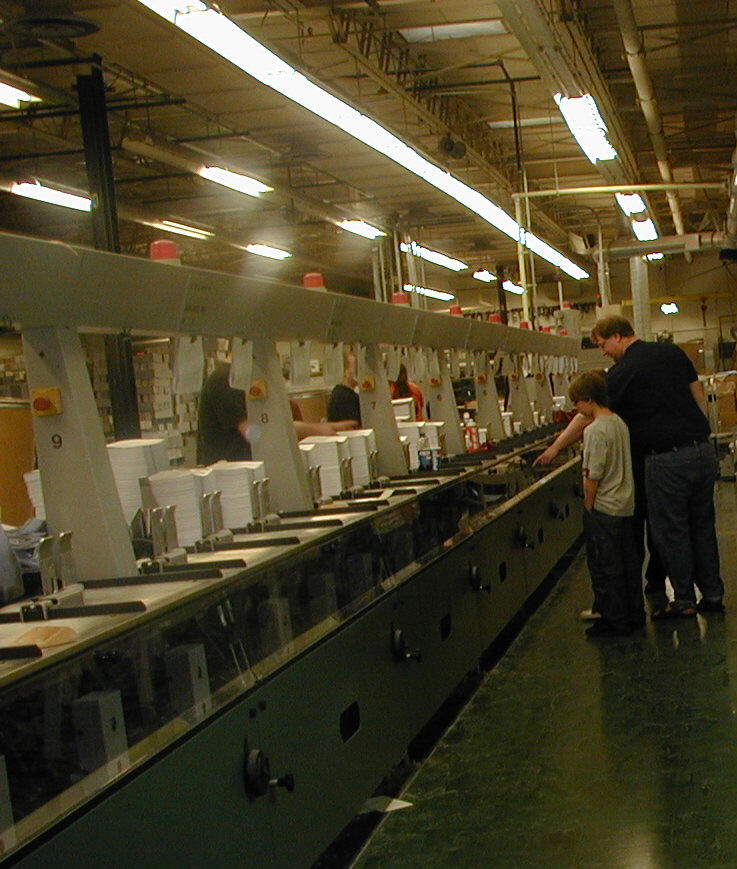
All of the sections were then stacked into the collating machine:
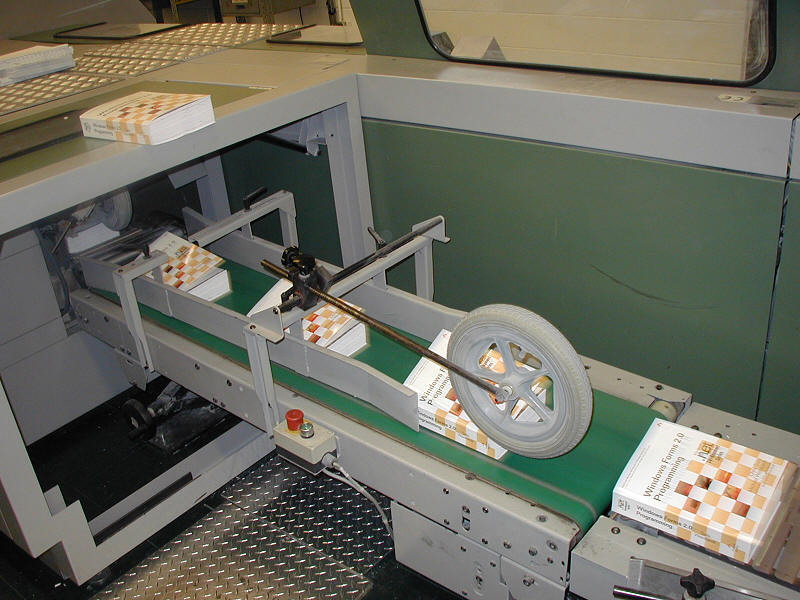
After this, my batteries ran out of power temporarily (they helpful staff at EB replaced em for me), so I can’t show you pictures, but once the books are collated and the spines bathed in glue at two temperatures (275 and 300 degrees Fahrenheit), the covers were attached and crimped and the books given the wheel treatment” as they exited the machine on their way to the cutter:
The cutter was this very scary machine they called the guillotine” and  was able to cut all three edges of my 1000 page book in a single slice and then stack the books into neat piles:
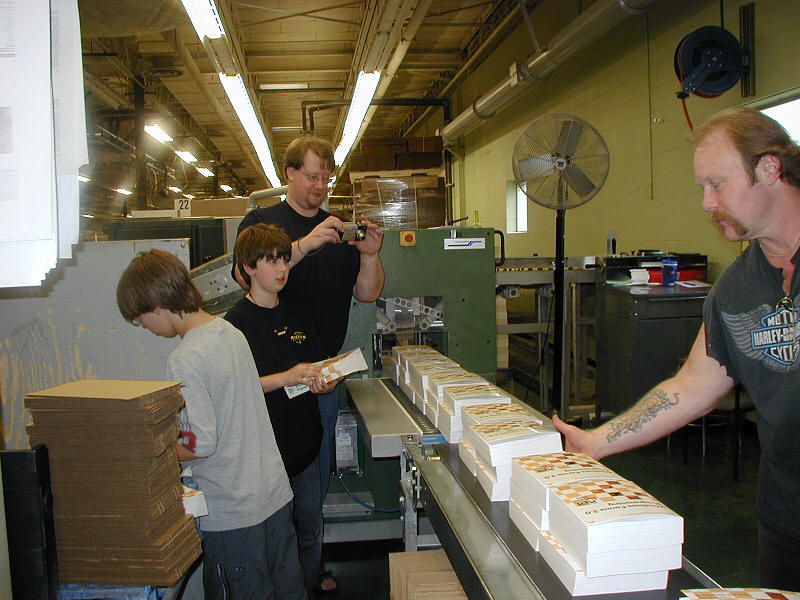
Not all the books survive the trip through the cutter (much like a real guillotine):
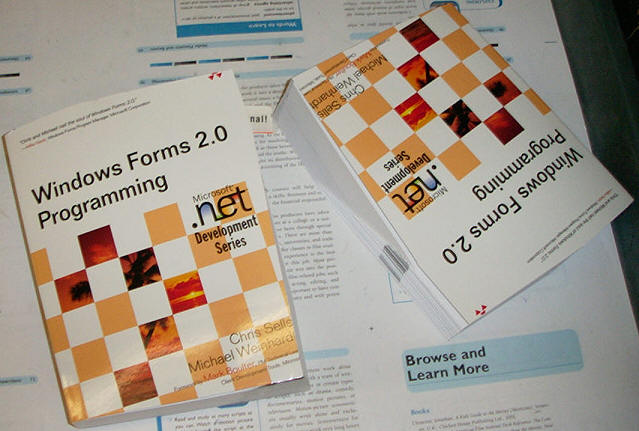
Once the books have been trimmed, they’re boxed and put on a conveyer to the shipping department. The shippers are responsible for lifting every single book (I apologized for my wordiness) and putting them onto palettes that are wrapped in plastic and hoisted by forklift:
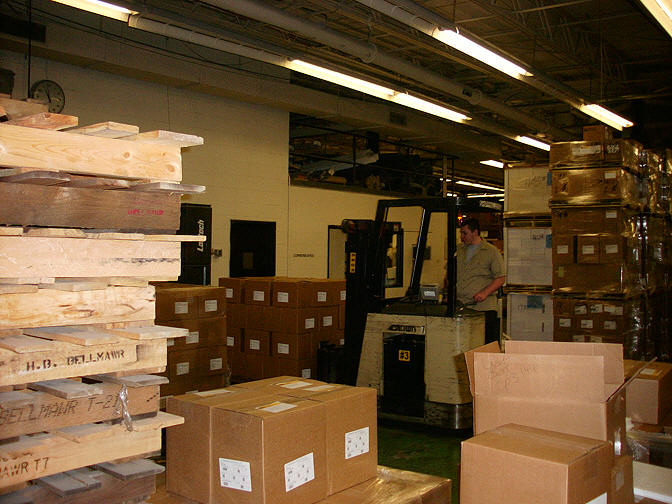
The forklift stacks each palette in the warehouse for shipping:
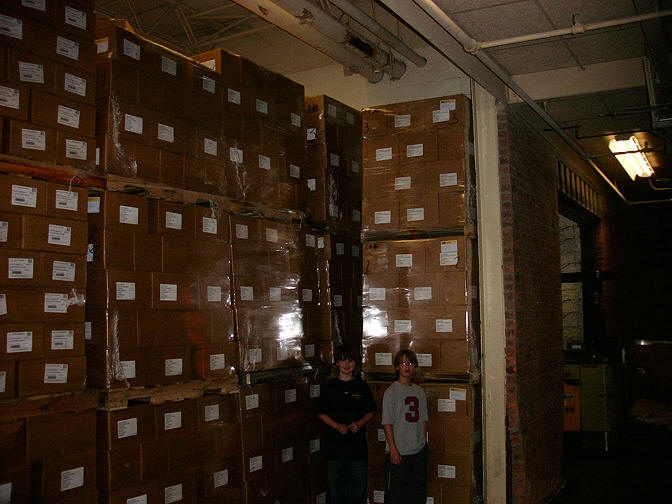
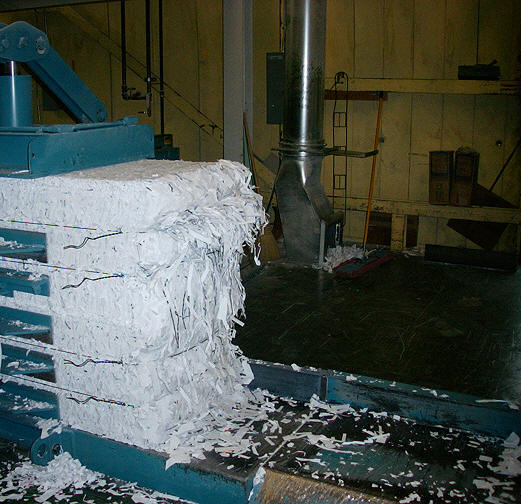
That’s not all. The little bits of paper that were the edges of my book and the low quality copies are shredded and compressed into giant chunks:
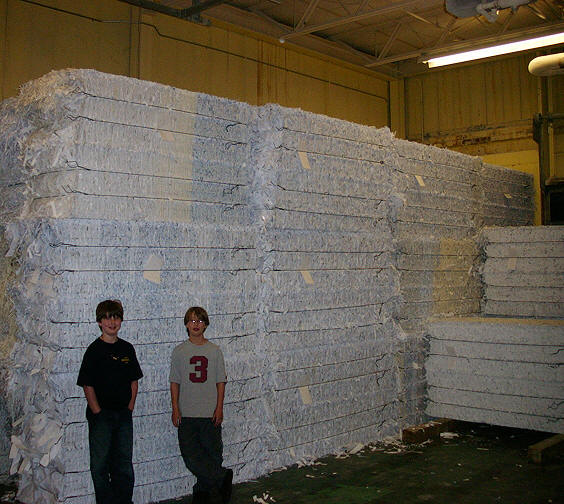
Like the books, the cubes of paper are stacked in the warehouse for shipping:
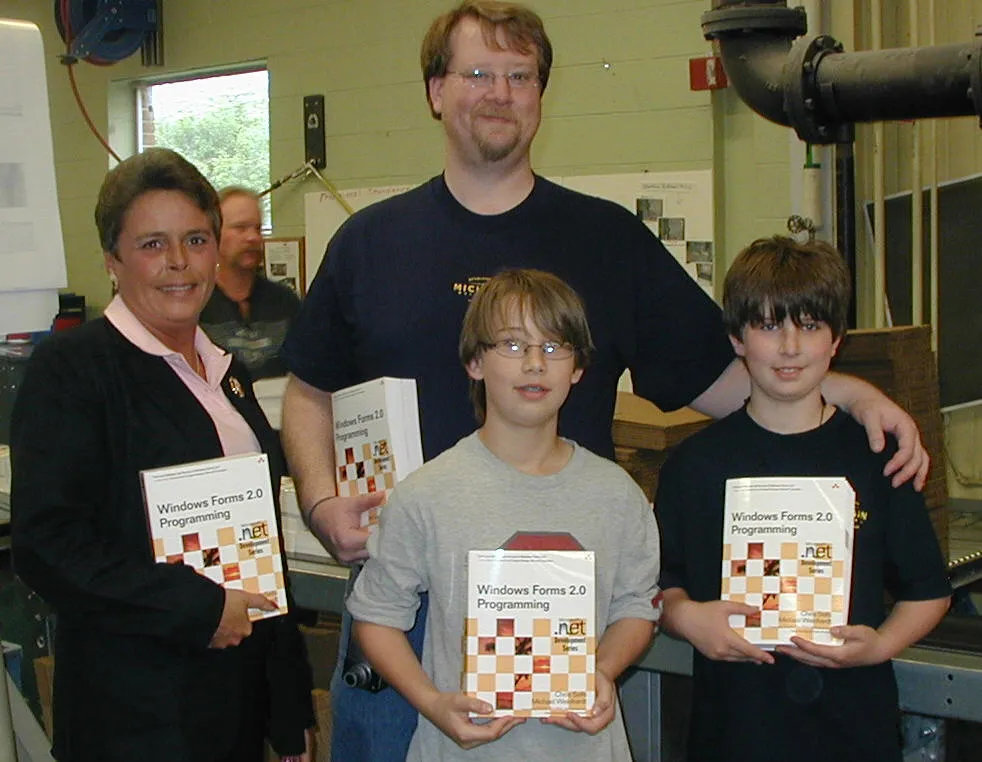
The waste paper is shipped off to a recycler for use in other books, whereas the books themselves are shipped to distributors, like Amazon, Borders and Barnes & Noble. By now, the first of the pre-orders should be being fulfilled. The ones that aren’t sent off for sale are given to vain authors that need a physical manifestation of their work to really understand the amount of time and energy that goes into producing their book:
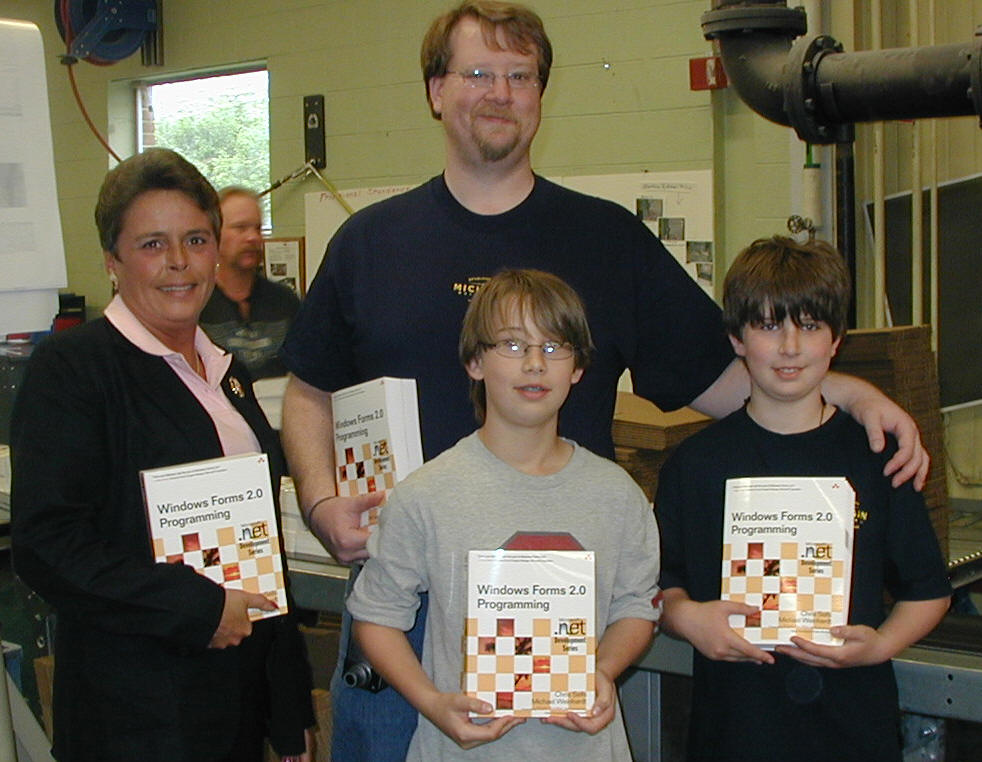
Special thanks go to Cindy, who was our most gracious hostess and to the staff and management of Edwards Brothers, Inc, for their work in producing such a high quality product. I also have to thank the boys for their infinite patience in indulging their father traveling to the middle west of our country to hang out amongst the stacks and stacks of books in progress. And, of course, thanks go to the readers. I hope you enjoy reader the book as much as I enjoyed working on it.